Why Sandcastles?
Sandcastle Research is a project of Renovation Psychology® by Dr Debi Warner

How do children express themselves in their sand play?  Does it have anything to do with their later abilities?  What fun times at the beach can do for self esteem, coordination, and perserverence?  Dr Debi Warner of Renovation Psychology will be attending the East Hampton Annual Sandcastle Competition.  She will be collecting information for her research on Sandcastles and their relationship to children's development and adult building skills.  Visit her tent on the beach August 4th!


Home
Why Sandcastles?
Preliminary Data
Beach Pictures

Blog what you think!

What is Renovation Psychology
all about?

See Main Website

Renovation Psychology is all about the human side of the Hammer!


Who is Dr Debi Warner?
Dr Debi Warner is a Clinical Psycholgist with a life time of Home Renovation in her toolbelt!
Read Dr Debi's Bio

Introduction:

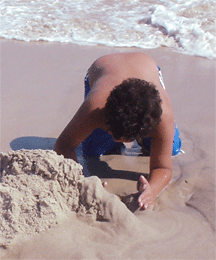
Why castles at the beach?  The beach provides an ideal environment for personal expression.  The child at the beach may play with the elements in any fashion, without inhibition.  Other than making sure to honor other people's space and safety, the child is free to play for long periods of time, to explore, to experiment, to discover and to invent.

Elements of Sand play at the beach
  • A centering environment - sound of the droning tide in the background, the visuals of long perspectives across the water, physical warmth, cheerful sun shine.

  • Relaxed - Parents are occupied, the children are safe and observed, a relaxed atmosphere for most families

  • Purity of purpose - the child may play without interference from adults into the child's task; not judged, no one cares what they make

  • Availability of resources - plenty of sand, space, water, shells, seaweed, trinkets

  • Visually interesting and accepting - the waves are always different.  In itself the diversity of waves and nature communicates that all have equal opportunity on the beach; no one is rejected.

  • Parallel play - others doing variety of similar tasks provide inspiration, but diversity does not mean judgment

  • Time - plenty of it - to dive into your activity and satisfy your own desires

  • Kinesthetic - the child can feel the textures, temperatures, and resistance of different mixes of sand and water, at the beach's surface and at various depths while digging.

  • Proprioceptive - the child's body senses and reacts to the movements in the sand.  It can be a whole-body experience or just a subtle move of the hand.  All of these repetitive motions provide feedback to the brain of sensations to be processed with the overall experience.

  • Social - the child can play with peers, siblings, and even stranger children.  They may peacefully engage in cooperative sand play, all contributing their talents to a larger effort

  • Non-verbal - the children do not need to use words in order to play together or alone in this environment.  The play equalizes across dimensions that stratify in regular school settings, since verbal prowess is irrelevant.

In this relaxed and generous situation, the children may pursue many spurts of action.  Exploring movements and materials until they sense they are pursuing a satisfying mission in the sand. 

A child may spend minutes exploring a construction technique for a particular section of their wall.  They place the sand, pat it, it crumbles.  Again, it crumbles.  They look, they feel.  They try again and again.  Children pour themselves into their sand play to their satisfactionThere is no waste of time, since time is ample; there is no waste of sand - it is ample too.  They make mistakes many times over until they stumble onto a new method - perhaps using a twig as a tool, or wetter sand, or another child suggests a new way.  Or perhaps they abandon that aspect and go in another direction, digging instead, or building a moat. 

The minutes and hours pass; they pour their creativity into the hole they dig.  They receive back satisfaction.  They continue on with action-motions that are rewarding to their eyes, hands, senses, drives, and evolving goals.  They become lost in time as they enter into a harmony with their sand project.  It may be difficult to get their attention if you are not one of the elements they are handling ~ sand, water, tools, or playmates.  They are oblivious to parents' calls, neighboring play, and the tide water advancing until it touches their feet, or their castle.

By the time they are done with their play, their castle reflects their most sustained efforts and interests, as well as by absence, the avoidance of those techniques they could not master.  They play until they are satisfied.  At that point, they usually go and find someone to admire their project. 

Then the tide comes and they must handle adversity

How does the child deal with the onslaught of nature's force?  At young ages, tears are likely (and at older ages too).  Yet the desire to survive, for one's creative project to endure, will emerge and fuel some kind of saving action.  How much scrambling will take place?  Will additional structures be tried?  Will cooperation be sought to make hasty tidal walls with many hands to help?  How much drive will the child use to combat the threat to their castle?  What does this say about their vision, drive, and ability to muster cooperation for a goal?

Do QUICK SURVEY

.


Home • Why Sandcastles? • Preliminary Data • Beach Pictures

DrWarner @ RenovationPsychology.com  (Please remove the spaces before and after the @ to send)
Media Kit

We hope you make great progress on your home construction and that the process strengthens your family and close relationships.
The opinions offered in this website, our research, workshops, columns, and books are not meant to replace medically necessary psychological care and do not constitute a doctor-patient relationship between Dr. Warner and you or any one reading this material.  We provide our services solely for enlightenment and to provide additional perspectives that can help people find their way through renovations in a positive and growth enhancing way. 
The publisher and author reserve the right to change terms and edit content on this website and the book as it suits the emerging technologies and needs of the Home Teams, the author, and the publishing house.

Renovation Psychology for True Home Improvement!

Website by Renovation Psychology® 
©2000-2007 by Dr. Deborah Warner, of Renovation Psychology® all rights reserved.
Comments about this site may be sent to webmaster @ RenovationPsychology.com
(Please remove the spaces before and after the @ to send)
Renovation Psychology® Dr Debi® and Logo are registered Trademarks/Service Marks of Renovation Psychology LLC.  All rights reserved.  You may reference our materials liberally, but may not call other products not licensed by Renovation Psychology LLC by these names.